Fact-Checked
On Sunday morning, November 15, a 74-year-old woman was struck and killed at West 118th Street and Frederick Douglass Boulevard in Harlem. According to the NYPD, as reported by Patch, an SUV traveling east on West 118th Street turned left onto Frederick Douglass Boulevard and hit her while she was crossing in a marked crosswalk. The driver stayed at the scene. Police told Patch that no arrests have been made and the investigation is ongoing.
We do not know what the investigation will find, and nothing in this article is a conclusion about who was at fault in that crash. Our thoughts are with her family. What we can do is explain the rules that apply every time a driver and a pedestrian meet at a New York intersection, because most people, drivers and walkers alike, have never been told what those rules actually say.
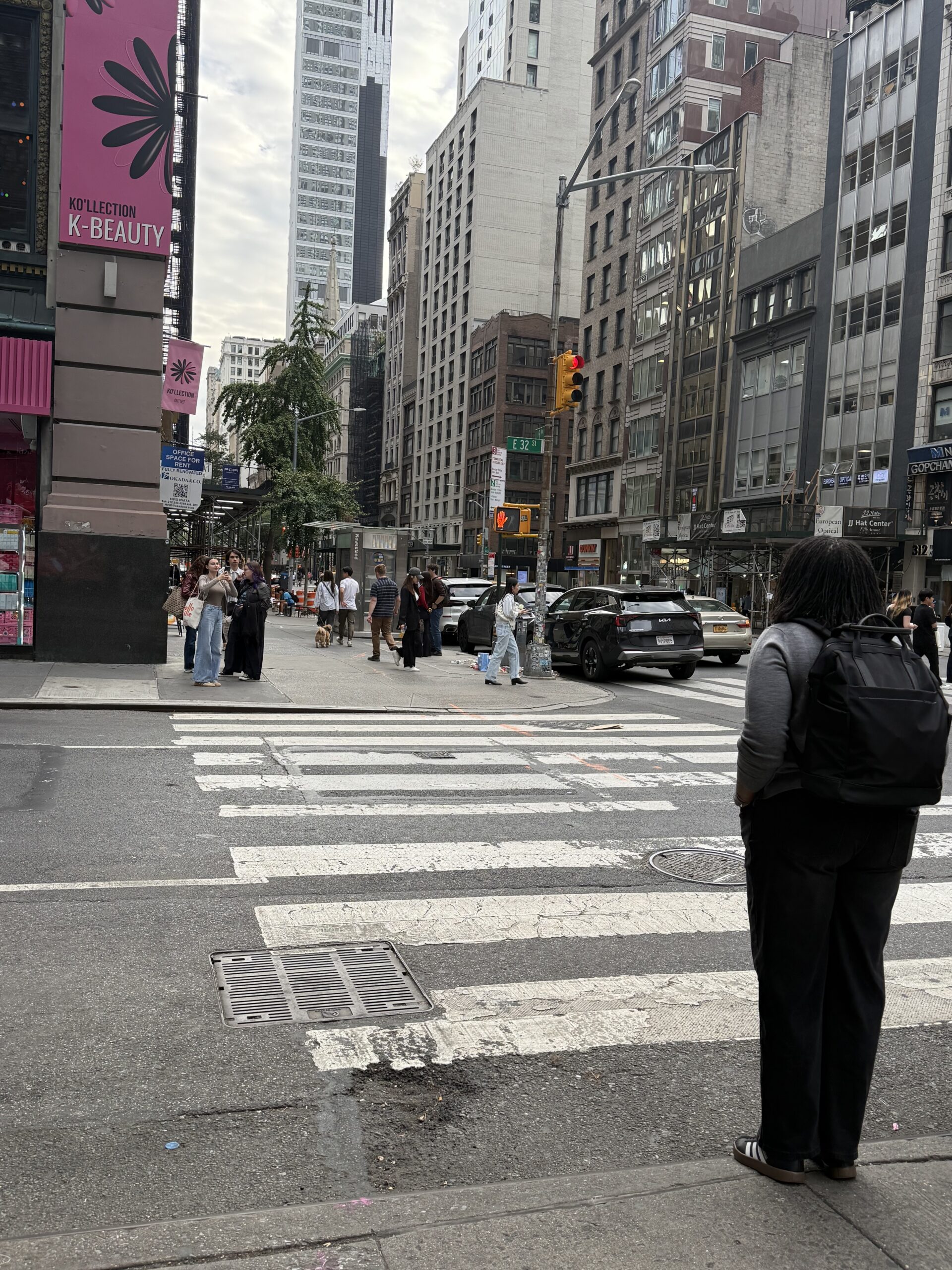
This is the single most misunderstood point in pedestrian cases. Many people assume that if there are no white lines on the road, there is no crosswalk. New York law says otherwise.
Vehicle and Traffic Law Section 110 defines a crosswalk two ways. First, it is the part of the roadway at an intersection that falls between the sidewalk lines on opposite sides of the street, extended across the road from curb to curb (or, where there are no curbs, across the traversable roadway). Second, it is any part of the roadway, at an intersection or anywhere else, that is marked for pedestrian crossing by lines or other markings.
Put simply: at an ordinary intersection with sidewalks, the space where the sidewalk would continue across the street is a legal crosswalk whether or not anyone ever painted it. New York State’s own pedestrian safety guidance says the same thing: that area is a crosswalk whether it is marked or not. Because the Vehicle and Traffic Law defines a crosswalk to include the unmarked kind, the right of way rules that protect a pedestrian crossing “within a crosswalk” apply to unmarked crosswalks at intersections too.
Away from an intersection the rule changes. In the middle of a block, there is a crosswalk only if one is marked. A pedestrian who crosses mid-block, or anywhere outside a marked or unmarked crosswalk, must yield the right of way to vehicles (VTL Section 1152(a)). Pedestrians also may not cross an intersection diagonally unless signs or signals allow it (VTL Section 1152(c)).
Why this matters in a real case: insurance adjusters sometimes write “pedestrian not in crosswalk” on a file simply because there were no painted lines. If the person was crossing at the intersection, in line with the sidewalks, that description may be wrong, and it can change who had the right of way.
Most crosswalk crashes in New York City happen at signalized intersections, and a large share involve turning vehicles. A driver making a turn is looking for a gap in oncoming traffic, while the pedestrian is often in the crosswalk the driver is turning into.
VTL Section 1111 governs traffic signals. Under Section 1111(a)(1), a driver facing a steady green light may go straight or turn left or right (unless a sign prohibits the turn), but a turning driver must yield the right of way to other traffic lawfully within the intersection or an adjacent crosswalk at the time the signal is shown. The same yield duty applies to drivers turning on a green arrow (Section 1111(a)(2)).
On the pedestrian side, Section 1111(a)(3) provides that a pedestrian facing a steady green signal may proceed across the roadway within any marked or unmarked crosswalk, unless a pedestrian signal (WALK / DON’T WALK, or the walking person and hand symbols) directs otherwise, and except where the only green showing is a turn arrow. Where a pedestrian signal is posted, that signal controls (VTL Section 1112).
Put together: when the light lets a pedestrian cross, a driver turning across that crosswalk has to wait. Having a green light gives a driver permission to turn. It does not give the driver the right to turn through someone who is lawfully crossing.
At crosswalks without working traffic signals, VTL Section 1151 sets the rule. A driver must yield to a pedestrian crossing within a crosswalk, slowing down or stopping if necessary to do so. That applies to marked crosswalks and to unmarked crosswalks at intersections, for the reasons explained above.
Section 1151 also puts obligations on pedestrians and other drivers:
Right of way rules decide who should go first. VTL Section 1146 goes further. It requires every driver to exercise due care to avoid colliding with any pedestrian or bicyclist on any roadway, and to sound the horn when necessary. That duty applies “notwithstanding the provisions of any other law,” which means it applies even where the pedestrian did not have the right of way. A pedestrian crossing mid-block may have to yield, but a driver who sees, or should have seen, that pedestrian still has to try to avoid hitting them.
Section 1146 also carries its own penalties. A driver who fails to exercise due care and causes physical injury to a pedestrian or bicyclist commits a traffic infraction punishable by a fine of up to $500, up to 15 days in jail, or both. Where the injury is a serious physical injury, the fine rises to $750 and the court may require a driver safety course and suspend the driver’s license or registration. A repeat violation within five years is a misdemeanor. The statute also creates a rebuttable presumption that a driver who failed to exercise due care caused the injury.
In civil cases, courts apply a related principle: a driver is expected to see what is there to be seen through the proper use of their senses. A driver who says “I never saw her” is often describing the problem, not offering a defense.
Inside the five boroughs there is an additional layer. In 2014, as part of Vision Zero, the City Council enacted Administrative Code Section 19-190, commonly called the Right of Way Law. Under it, a driver who fails to yield to a pedestrian or bicyclist who has the right of way commits a traffic infraction. If the vehicle makes contact with that person and causes physical injury, the offense becomes a misdemeanor. The law does not apply where the failure to yield and the injury were not caused by the driver’s failure to exercise due care.
Families are often confused, and understandably upset, when they hear “no arrests have been made.” It is important to understand that a criminal or traffic charge and a civil injury or wrongful death claim are two different things:
A driver who is never charged can still be held responsible in a civil case. The outcome of any traffic or criminal case can matter to the civil case, but it does not decide it.
In New York, an unexcused violation of a Vehicle and Traffic Law provision is negligence per se, which means it establishes negligence unless the driver can show a valid excuse. A violation of a city rule or Administrative Code provision, including the Right of Way Law, is treated differently: it is only some evidence of negligence for the jury to weigh. That is why the state right of way rules discussed above matter so much in pedestrian cases.
Where the evidence clearly shows that a driver turned into a pedestrian who was lawfully crossing in a crosswalk, the injured person may be able to ask the court to decide liability before trial, through a motion for summary judgment, rather than leaving fault entirely to a jury. That route is less certain in motor vehicle cases than it used to be. The 2026 changes described below make the comparison of fault central to the case, and the amended no-fault law now has the trier of fact decide who was at fault before it reaches the question of serious injury. Courts are still working out what that means for summary judgment on liability.
The evidence that wins or loses that question tends to disappear quickly: traffic and building camera footage, the signal timing at the intersection, vehicle data, and the names of witnesses. Much private video is recorded over within days or weeks.
Defendants in pedestrian cases almost always argue that the person who was struck shares the blame: they were looking at a phone, crossing against the signal, outside the crosswalk, or wearing dark clothing at night. How much that argument matters depends on New York’s comparative fault rule, and that rule changed this year for motor vehicle cases.
Since 1975, CPLR 1411 has made New York a “pure” comparative negligence state. A person’s own carelessness does not bar recovery. Instead, the damages are reduced in proportion to that person’s share of fault. If a jury values a case at $1,000,000 and finds the injured person 20 percent at fault, the recovery is $800,000. That rule, now found in CPLR 1411(a), still governs construction, premises, product and most other injury cases.
As part of the 2026 state budget, the Legislature added CPLR 1411(b). For personal injury actions subject to Article 51 of the Insurance Law (New York’s no-fault motor vehicle law) that are commenced on or after May 26, 2026, an injured person whose share of fault is greater than the defendant’s share, or greater than the combined share of all the defendants, is barred from recovering at all.
Pedestrians struck by vehicles generally fall within the no-fault system, so this change is likely to matter in many pedestrian injury lawsuits filed from now on. In practical terms: a pedestrian found 40 percent at fault still recovers 60 percent of their damages, but a pedestrian found more at fault than the driver may recover nothing. Courts have not yet worked out every question the amendment raises, including exactly how fault is compared when there are several defendants.
This makes the early investigation even more important than it used to be. The difference between a pedestrian who was “partly at fault” and one who was “mostly at fault” is now, in many motor vehicle cases, the difference between a reduced recovery and no recovery.
A pedestrian hit by a car in New York generally looks first to no-fault insurance, typically the coverage on the vehicle that struck them. No-fault pays basic economic loss, including medical treatment and a portion of lost earnings, regardless of who caused the crash, up to the policy’s limits. This is often the answer to the question “I don’t have health insurance, how do I get treated?” The application deadline is short, generally 30 days, so it should be filed right away.
To sue the driver for pain and suffering, a person injured in a motor vehicle crash must show a “serious injury” as defined in Insurance Law Section 5102(d), such as a fracture, significant disfigurement or a significant limitation of use of a body function or system. For lawsuits filed on or after May 26, 2026, the 2026 budget also removed one of the categories that injured people commonly relied on: the “90/180 day” category, which covered injuries that kept a person from performing substantially all of their usual daily activities for 90 of the first 180 days. Lawsuits filed before that date remain under the old rule. Death claims are not subject to the serious injury threshold.
The vehicle’s owner, not just the driver, can be responsible. Under VTL Section 388, the owner of a vehicle is generally liable for the negligence of anyone driving it with the owner’s permission. When the vehicle is a commercial truck, a rideshare car, a city vehicle or a bus, other parties and other rules come into play. Claims against the City of New York and many public authorities require a notice of claim, usually within 90 days.
When a pedestrian dies, the claim belongs to the estate and is brought by a personal representative appointed by the Surrogate’s Court. A wrongful death action generally must be started within two years of the death (EPTL 5-4.1), a shorter deadline than the three years that usually applies to injury claims. The same two-year period applies when the defendant is the City of New York, but a notice of claim must be served first. In a wrongful death case, the 90 days for that notice run from the appointment of the estate’s representative, not from the date of death, so opening the estate promptly matters.
New York’s wrongful death statute (EPTL 5-4.3) limits recovery to “pecuniary” loss: the financial support, services, care and guidance the family has lost, plus medical and funeral expenses. It does not allow recovery for the family’s grief or loss of companionship. Separately, the estate may recover for any conscious pain and suffering the person experienced before death (EPTL 11-3.2). That is a different claim from the wrongful death claim, and its deadlines can be shorter. Against the City of New York, for example, a claim for the person’s own pain and suffering must be started within one year and 90 days of the injury, and its notice of claim is due within 90 days of the accident.
This is where New York law treats older New Yorkers unfairly. When the person who died was retired, there may be no lost wages to measure, and the law can make it look as if the loss of a grandmother who cared for grandchildren, cooked for her family and anchored a household is worth very little. Careful work goes into proving the real value of the services and guidance a family has lost. The Grieving Families Act, which would allow families to recover for grief and loss of companionship, has passed the Legislature more than once and has been vetoed each time. As of this writing, it is not law.
Every driver in this city has been in a hurry to make a left turn before the light changes. Before turning, look into the crosswalk you are turning into, not just at oncoming traffic. Remember that the crosswalk exists whether or not it is painted. Slow down enough to stop. Large vehicles and SUVs have pillars and hoods that can hide a person, especially someone shorter or moving slowly, so look twice. The few seconds saved by turning early are never worth it.
For more on what to do after a pedestrian accident, read our guide, Injured While Walking in NYC: What You Should Know About Pedestrian Accidents.
We represented an elderly woman who was knocked down by a driver who failed to yield while she was crossing a Brooklyn street in a crosswalk. Within weeks, the driver’s insurance company offered its policy: the New York State minimum of $25,000. Our investigation showed the driver was traveling between work appointments when he hit her, which brought his employer into the case. The court granted summary judgment on liability, holding that the driver failed to yield the right of way, and the case resolved for $4,025,000 less than two years after the crash. Read the full story: $4.025 Million Settlement for an Elderly Pedestrian Struck in a Brooklyn Crosswalk.
We also resolved a separate case for a pedestrian hit in a crosswalk for $1,950,000. See more on our Results page.
Darren T. Moore is the founder of MooreJustice Accident & Injury Lawyers in New York City. He is a trial lawyer who represents people seriously injured in construction accidents, truck and car crashes, pedestrian knockdowns and medical malpractice cases, and families who have lost a loved one. Learn more about our New York pedestrian accident practice and our wrongful death practice.
This article is general information about New York law and is not legal advice. Every case depends on its own facts. Attorney Advertising. Prior results do not guarantee a similar outcome.
Sources: Patch (Harlem), “Pedestrian, 74, Dies After Being Struck By SUV In Harlem, Police Say” (Nov. 16, 2026); N.Y. Vehicle and Traffic Law Sections 110, 388, 1111, 1112, 1146, 1151, 1152; N.Y. CPLR 1411; N.Y. Insurance Law Sections 5102, 5104; N.Y. EPTL 5-4.1, 5-4.3, 11-3.2; N.Y. General Municipal Law Sections 50-e, 50-i; N.Y.C. Administrative Code Section 19-190; New York State pedestrian safety guidance (ny.gov).
Business Name: MooreJustice Accident & Injury Lawyers
Business Address: 171 Madison Avenue, Suite 305, New York, NY, USA
Business Phone Number: +1 (917) 809-7014

Darren Moore is the founder of The Law Offices of Darren T. Moore, P.C. and a dedicated New York personal injury attorney. Known for his relentless advocacy and client-focused approach, he has spent his career helping injury victims pursue justice and recover the compensation they deserve. Darren handles a wide range of personal injury matters and is committed to delivering personalized representation for every client.


schedule a free consultation
"*" indicates required fields