Fact-Checked
One construction worker died and another remains missing after a scaffold collapse beneath the Loop Parkway bridge in Point Lookout, Nassau County, just before noon on Wednesday, Nov. 11, according to New York State Police. Temporary scaffolding under the drawbridge gave way. Six other workers were hurt, and police described their injuries as not life-threatening.
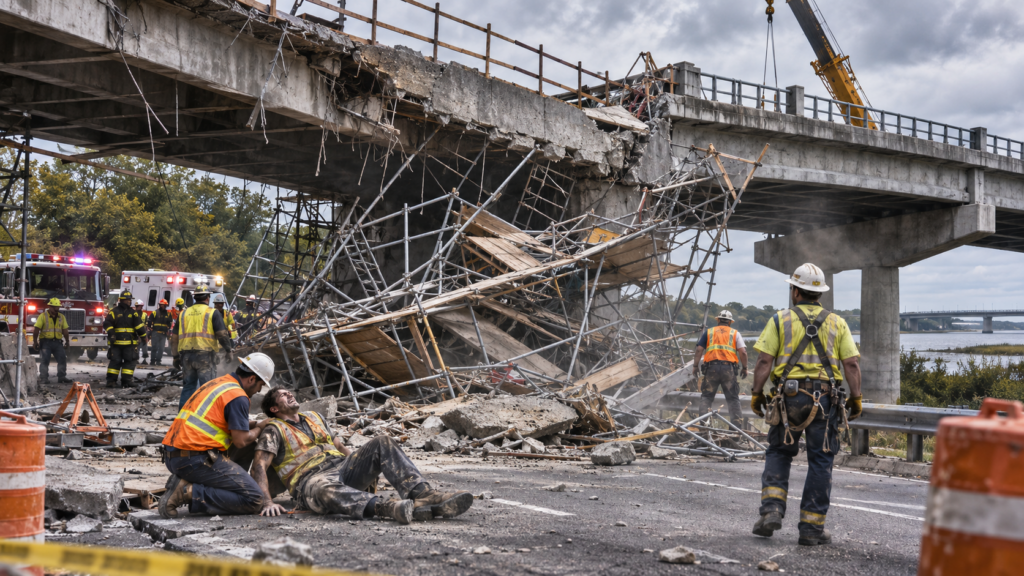
A crew of eight was painting and repairing steel on the drawbridge over Reynolds Channel when part of the scaffolding underneath the span collapsed, CBS New York reports. Two workers fell into the water. One crew member jumped about 50 feet into the channel to try to reach them, and nearby tow boat operators helped police bring a third worker, stranded at the base of the bridge, to safety (CBS New York).
One of the workers who fell into the water died at a hospital. As of the most recent reports, from Friday evening, Nov. 13, the search for the second worker was continuing, with no recovery announced (CBS New York). The construction company, which has not been named in coverage, said it was heartbroken and thanked first responders, according to CBS New York.
CBS New York reports that OSHA, the state Department of Transportation and New York State Police will examine what went wrong, and that police will also determine whether criminal negligence played a role. State Police say the incident remains under investigation. No cause has been announced, and no citations, charges or lawsuits have been reported.
New York gives construction workers some of the strongest protections in the country.
Under the New York Scaffold Law (Labor Law 240(1)), owners, general contractors and their agents must provide scaffolds, safety lines and other devices that give proper protection against falls from height. The law covers painting and repairing a structure, and courts have applied it to bridge work (Dougherty v. State, 113 A.D.2d 983 (3d Dep’t 1985)). Liability is absolute, meaning a worker’s own carelessness is not a defense (Blake v. Neighborhood Housing Services, 1 N.Y.3d 280 (2003)). The one exception is when the worker’s own conduct was the sole cause of the accident, which generally requires proof that proper safety devices were available, the worker knew to use them, and chose not to for no good reason.
For more on how these rules work together, see our guide to New York Labor Law 200, 240(1) and 241(6).
Owners and contractors must comply with specific state safety rules for construction, including rules on scaffolds (12 NYCRR Part 23-5) and on drowning hazards, which call for rescue equipment such as a manned boat, life preservers and a life ring where workers are exposed to falling into water (12 NYCRR 23-1.7(c)).
OSHA standards address scaffold design and inspection, and require life vests, ring buoys and a rescue boat when employees work over or near water. OSHA generally has six months to issue citations after an incident.
Injured workers generally receive workers’ compensation from their employer, and usually cannot sue that employer directly. They may still have claims against the property owner, general contractor or other companies on the job.
When a worker dies, the family’s claims generally include:
If the State owns the bridge, claims against the State go to the New York Court of Claims, which has strict filing deadlines. For injury, a claim or a notice of intention generally must be served on the Attorney General within 90 days of the accident. For wrongful death, the 90 days runs from the appointment of the estate’s representative, and the claim must in all events be filed within two years of the death.
A collapsed temporary structure is often removed quickly. That makes the work of OSHA and State Police investigators, and the preservation of the scaffolding, rigging and inspection records, critical to understanding what failed. A criminal review and any civil claims run on separate tracks and timelines.
Our thoughts are with the workers, their families and their coworkers. We will update this post as officials release findings.
Darren T. Moore is the founder of MooreJustice Accident & Injury Lawyers in New York City. He tries construction accident, commercial trucking and medical malpractice cases to verdict across New York. Darren spent his summers working in construction, and he brings that job-site knowledge to every construction case, from the trades and the equipment to the walkways and elevated work.
This article is general information about New York law and is not legal advice. Attorney Advertising. Prior results do not guarantee a similar outcome.
Sources: New York State Police and CBS New York (Nov. 2026); Labor Law section 240(1); Dougherty v. State, 113 A.D.2d 983 (3d Dep't 1985); Blake v. Neighborhood Housing Services, 1 N.Y.3d 280 (2003); 12 NYCRR Part 23-5 and 23-1.7(c).
Business Name: MooreJustice New York City Accident & Injury Lawyers
Business Address: 171 Madison Avenue, Suite 305, New York, NY, USA
Business Phone Number: +1 (917) 809-7014

Darren Moore is the founder of The Law Offices of Darren T. Moore, P.C. and a dedicated New York personal injury attorney. Known for his relentless advocacy and client-focused approach, he has spent his career helping injury victims pursue justice and recover the compensation they deserve. Darren handles a wide range of personal injury matters and is committed to delivering personalized representation for every client.


schedule a free consultation
"*" indicates required fields