Fact-Checked
$4,060,000 settlement after summary judgment on liability. Construction Accident | Sidewalk Shed | Labor Law § 240(1) | Labor Law § 241(6) | Fall from Height | Summary Judgment on Liability
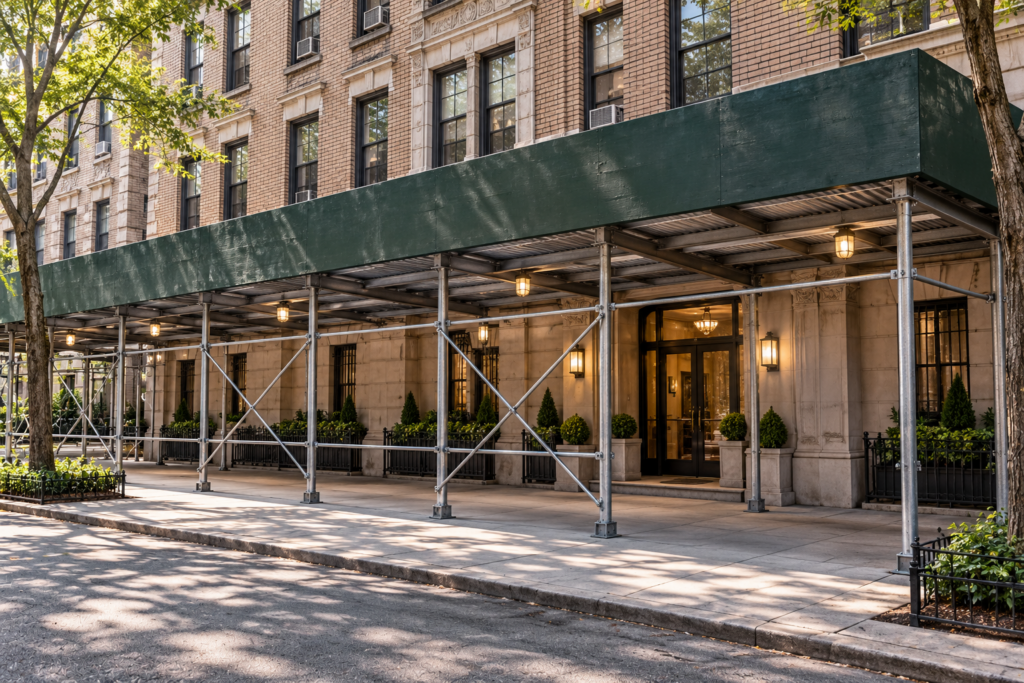
Sidewalk sheds are everywhere in New York City because of the facade safety law most New Yorkers still call Local Law 11. It exists for a good reason: to protect people walking beneath tall buildings from loose bricks and other material falling from the facade. Building exteriors must be inspected regularly, for decades every five years. When a building fails, repair work such as repointing has to be done to secure loose or failing masonry. Before that work starts, a permit is needed and a sidewalk shed has to go up, sometimes around the whole building. For more on how the law works and who is responsible, read our article on who is responsible for keeping NYC building facades safe.
A sidewalk shed is itself a kind of scaffold: steel posts and beams, a ceiling overhead, corrugated steel above that, and a deck of plywood sheets that catches falling material and gives workers a platform. Because sheds stand so high, you generally need a scaffold to put one up, and a scaffold to take one down.
Our client was a non-union laborer working for a sidewalk shed company. He reported to a building in Manhattan on a Friday morning and was told the shed had to be down by 12 o'clock.
He was sent to do the job without a scaffold, without a truck and without even a ladder. About ten minutes before the accident, he asked his foreman for a scaffold so the job could be done more easily and safely. The foreman said it would take too long and told him to just take it down and get it over with.
So the shed itself became his scaffold. He ended up standing on a steel beam about two stories, or roughly 20 feet, above the sidewalk. He was wearing a safety harness, but there was nowhere to tie it off, so it could not stop a fall. He fell about 20 feet to the sidewalk, and a steel beam fell with him.
He fractured his leg and his shoulder. The fall set off a cascade of injuries to his shoulder, his knee and his spine, followed by medical treatment, MRIs and CT scans, and ultimately surgery on the injured parts of his body.
Darren moved the case aggressively, as he always does. The case was venued in Brooklyn. Darren took our client's deposition and obtained sworn statements from two coworkers who saw the fall. They confirmed that he was wearing a harness with nowhere to tie it off, and that a scaffold would have been the safer way to do the job.
At the first opportunity, Darren moved for summary judgment against the building owner, the general contractor and the subcontractor under two sections of New York's Labor Law:
Want to understand how these protections work? Read our guide to New York Labor Law 200, 240(1) and 241(6).
The building owner put in a substantial opposition, including an affidavit from an engineer disputing our right to summary judgment on liability. A common response is to hire a competing expert, but that can turn the motion into a battle of experts and create the very question of fact the defense wants.
Darren did not hire one. The testimony of our client and the eyewitnesses, together with what the defense witnesses could not say, made the case. The engineer had not spoken to any of the witnesses or inspected the site, and his own report conceded that safer methods of removing the shed beams existed but were not chosen. Under Labor Law § 240(1), choosing those safer methods was the responsibility of the owner and contractors, not the worker on the beam.
The court granted summary judgment on liability under Labor Law § 240(1) and the applicable provisions of § 241(6).
The case moved toward trial, and on the eve of trial it settled for $4,060,000.
That's not luck, that's MooreJustice.
Hurt on a construction site in New York? Learn more about New York City construction accident claims, or see the case result.
Attorney Advertising. Prior results do not guarantee a similar outcome. This page describes a past matter for general information and is not legal advice.
Business Name: MooreJustice New York City Accident & Injury Lawyers
Business Address: 171 Madison Avenue, Suite 305, New York, NY, USA
Business Phone Number: +1 (917) 809-7014

Darren Moore is the founder of The Law Offices of Darren T. Moore, P.C. and a dedicated New York personal injury attorney. Known for his relentless advocacy and client-focused approach, he has spent his career helping injury victims pursue justice and recover the compensation they deserve. Darren handles a wide range of personal injury matters and is committed to delivering personalized representation for every client.


schedule a free consultation
"*" indicates required fields