Fact-Checked
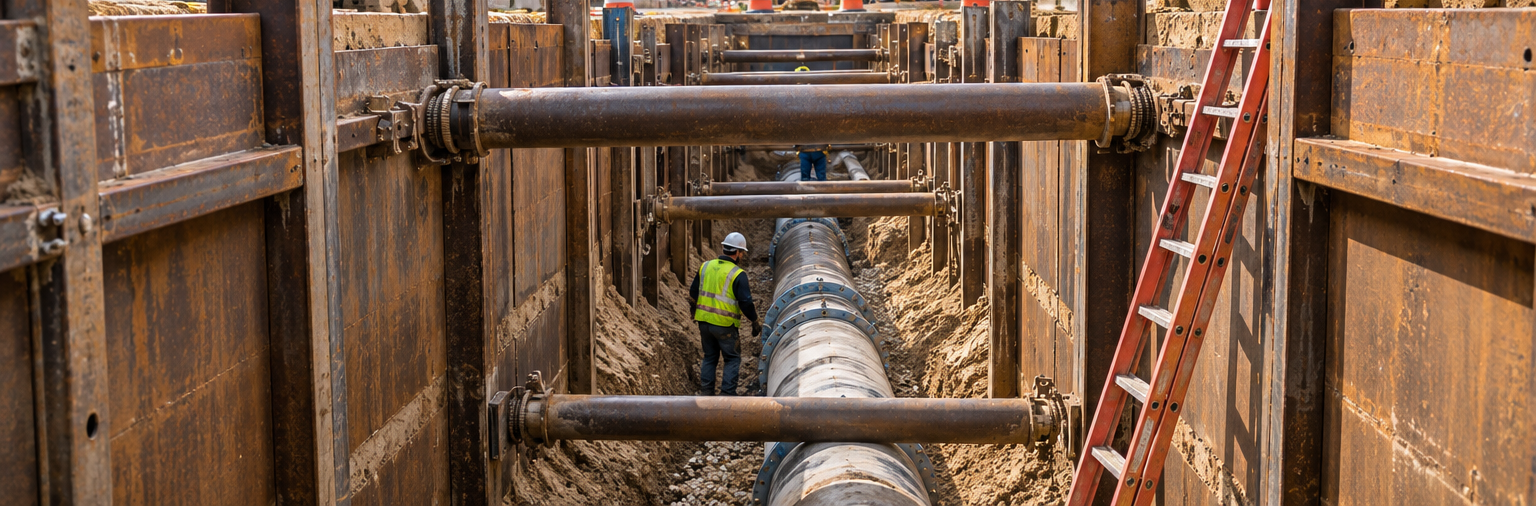
Every day, New York City streets are opened up for sewers, water mains, gas lines and utility work. Usually we see these at the weekends on certain streets. For example, along 2nd Avenue every weekend, some of the roads are shut down and construction vehicles and workers are hard at work within the trenches. Is it the 2nd Avenue subway line? New Con Ed piping? Or is it for fiber optic cables? Who knows. But what we do know is that the trenches that make that work possible are some of the most dangerous places on any construction project. When a trench wall gives way, or the steel and timber holding it back comes loose, the workers below have nowhere to go.
New York law treats this work as inherently dangerous, and it puts the responsibility for trench safety on the owners and contractors who profit from it. This guide explains how Labor Law § 241(6) and the Industrial Code's excavation rules protect workers in and around trenches, and what those rules actually require.
Labor Law § 241 applies to contractors and owners when they are constructing or demolishing buildings or doing excavation work in connection with it. Subdivision 6 sets the standard:
All areas in which construction, excavation or demolition work is being performed shall be so constructed, shored, equipped, guarded, arranged, operated and conducted as to provide reasonable and adequate protection and safety to the persons employed therein or lawfully frequenting such places.
Labor Law § 241(6)
Note the words "excavation" and "shored." The Legislature had trench work squarely in mind.
Most injured construction workers cannot sue their own employer because of the workers' compensation system. A § 241(6) claim is brought against the property owner and general contractor instead, which is why these rules matter so much. For the bigger picture, see our guide to New York Labor Law 200, 240(1) and 241(6).
Subpart 23-4 of the Industrial Code (12 NYCRR Part 23) governs excavation operations. These are the provisions that come up most often in trench collapse cases.
Where the sides can be cut back without undermining buildings, utilities or roads, the sides may be sloped instead of shored, but only to the angles in Table I, which depend on the soil and the depth. Stable rock may have vertical sides. Soft or wet soil needs a much gentler slope. When sloping and shoring are combined, the Code requires a level bench at least 24 inches wide between them.
Excavated soil and other loads must be kept at least 24 inches back from the edge of an open excavation and piled so nothing can slide, fall or roll in, unless a barrier is installed to hold it back. Loose rock and other material that could fall on workers must be cleared from the sides and the area around the excavation.
Open excavations next to a sidewalk, street or other public area must be effectively guarded with a substantial fence or barricade, sheeting extended at least 42 inches above the ground, or a properly supported covering strong enough for any vehicles that may cross it.
In one of our cases, a union carpenter was working on a City sewer and water main project in the Bronx when a trench wall collapsed. A heavy steel beam that had been supporting the wall fell four to five feet onto a coworker's leg. Our client climbed into the trench to lift the beam off him and suffered a herniated disc that eventually required a lumbar fusion. The claim was built on 12 NYCRR 23-4.2(a) and 23-4.4(a), (b), (c) and (f).
On appeal, the Appellate Division, First Department noted that the defendants did not dispute that those trench rules are specific enough to support a § 241(6) claim, or that they were violated. The question was whether the law protected a worker hurt rescuing someone else. The court held that it can (Leonard v City of New York, 216 AD3d 51 [1st Dept 2023]). The case later settled for $2,750,000. Read the full story, and see our guide to the danger invites rescue doctrine.
Trench collapse cases turn on the details: how deep the trench was, what the soil was, what shoring was used and whether it was inspected. We take these cases apart rule by rule, and we are prepared to take them to the Appellate Division and to trial. If you or a family member was hurt in a trench or excavation accident in New York, learn more about our New York City construction accident practice.
Attorney Advertising. Prior results do not guarantee a similar outcome. This article is general information, not legal advice. The Industrial Code is summarized from the published regulations; check the current official text before relying on it.
Business Name: MooreJustice New York City Accident & Injury Lawyers
Business Address: 171 Madison Avenue, Suite 305, New York, NY, USA
Business Phone Number: +1 (917) 809-7014

Darren Moore is the founder of The Law Offices of Darren T. Moore, P.C. and a dedicated New York personal injury attorney. Known for his relentless advocacy and client-focused approach, he has spent his career helping injury victims pursue justice and recover the compensation they deserve. Darren handles a wide range of personal injury matters and is committed to delivering personalized representation for every client.


schedule a free consultation
"*" indicates required fields