Verificado
Falls from height are among the most serious injuries we see on New York construction sites. A ladder kicks out, a plank gives way, a worker steps back off a sidewalk shed with nothing to tie off to. In many states, that worker’s only option is workers’ compensation. New York is different. For more than a century, the state has put the responsibility for height safety squarely on the owners and contractors who control a job, through Labor Law Section 240(1), often called the Scaffold Law.
This article explains what the law says, who it holds responsible, what an injured worker has to prove, and the defenses owners and contractors raise. It reflects appellate decisions issued through November 2026. It is written for workers and families trying to understand their rights, not as a substitute for advice about a specific case.
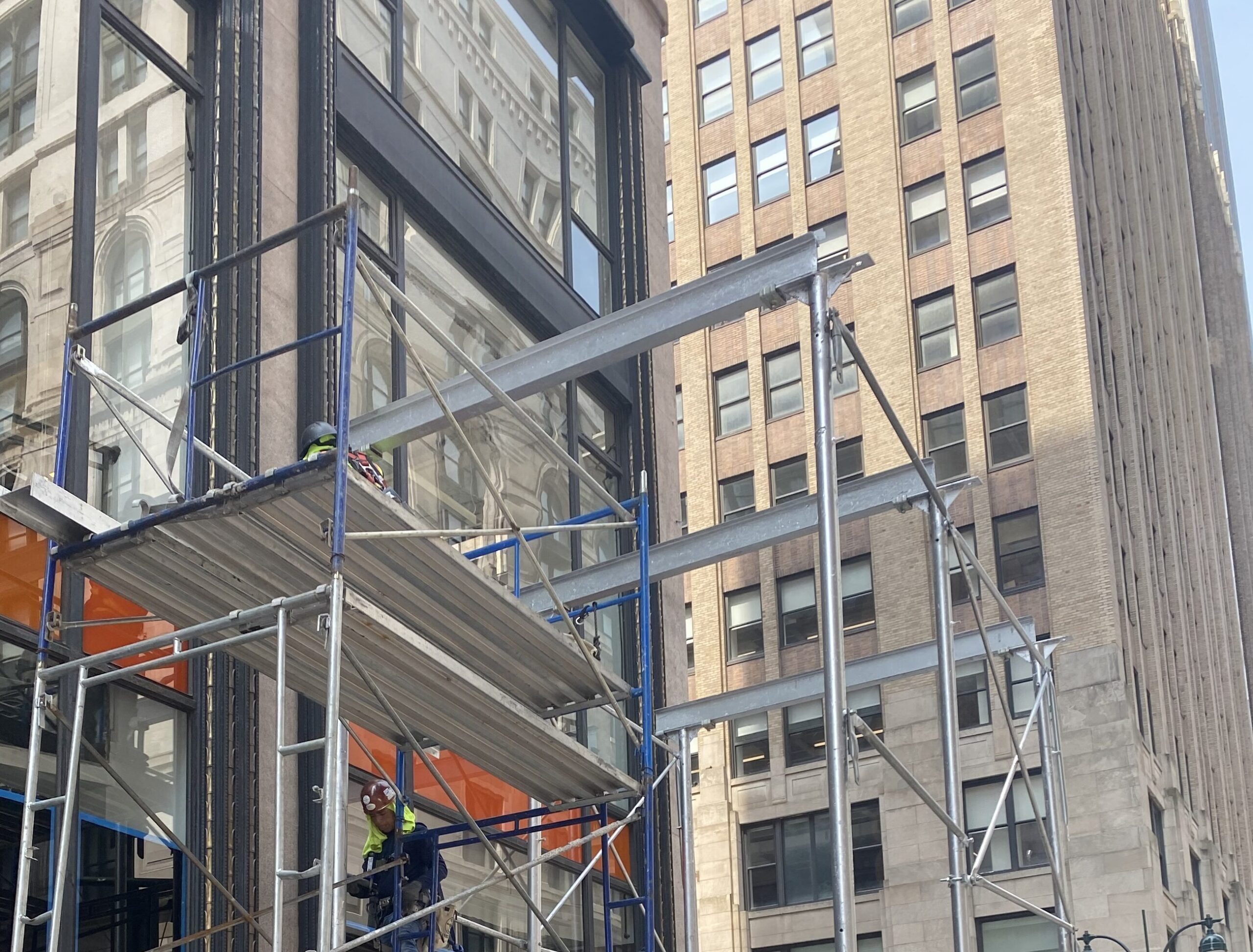
Section 240(1) applies to contractors, owners and their agents when a building or structure is being erected, demolished, repaired, altered, painted, cleaned or pointed. It requires them to furnish or erect, or cause to be furnished or erected, safety devices for the workers doing that labor: “scaffolding, hoists, stays, ladders, slings, hangers, blocks, pulleys, braces, irons, ropes, and other devices,” which must be so constructed, placed and operated as to give proper protection.
There is one statutory exception. Owners of one- and two-family dwellings who contract for the work but do not direct or control it are not covered. A homeowner who hires a roofer and stays out of the way is generally not liable under 240(1). A homeowner who tells the roofer how to do the job may be.
The duty under 240(1) belongs to the owner and the general contractor, and it is nondelegable. That means an owner cannot escape it by pointing to the subcontractor who hired the worker, or by showing it had nothing to do with the day-to-day work. An owner who never set foot on the site can still be liable.
Your own employer is usually not the defendant. Workers’ compensation is generally the exclusive remedy against an employer, so a 240(1) claim is brought against the owner and contractors above your employer. You can receive workers’ compensation benefits and bring a 240(1) claim at the same time.
Courts look at four questions.
The work must involve erecting, demolishing, repairing, altering, painting, cleaning or pointing a building or structure. Most construction and renovation work qualifies. Routine maintenance, such as replacing a part that wears out in the normal course, may not. Courts decide the line between a repair or alteration and routine maintenance case by case, looking at whether the item was broken or inoperable before the work began and whether the job meaningfully changed the building.
A First Department decision issued on November 17, 2026 shows how far coverage can reach. A custodian cut open a gymnasium wall, replaced electric cable inside it and re-plastered the hole. The court held that was an alteration, not routine or decorative maintenance, and added that a change in structural integrity is not necessarily required for coverage (Arita v. FDS Assoc., LLC, 2026 NY Slip Op 06761 [1st Dept 2026]). Where the line falls depends on the facts, which is why the description of the job matters from day one.
Section 240(1) protects against risks that come from a difference in height: a worker falling from a ladder, scaffold, roof or floor opening, or an object falling on a worker because it was not properly hoisted or secured. An ordinary trip on a flat surface is not covered by 240(1), though it may be covered by other sections of the Labor Law.
The height does not have to be dramatic. In October 2026 the First Department held that a fall from a height of two feet can be the kind of elevation-related risk the statute covers, in a case where a worker fell from an unsecured A-frame ladder after a falling sheet of plywood struck it (De Souza v. 4720 Third Ave LLC, 2026 NY Slip Op 05905 [1st Dept 2026]). Not every covered case is a worker falling, either. Materials that fall on a worker, or loads that swing and strike one, can be just as covered, and they have to be analyzed against how the job was actually being run.
Liability follows when the required device was not provided, or was provided but did not give proper protection. In practice that includes:
The courts have been consistent on ladders. In April 2026 the Second Department granted a worker summary judgment on liability where his unsecured ladder moved suddenly and tilted, repeating the rule that “where a ladder slides, shifts, tips over, or otherwise collapses for no apparent reason, the plaintiff has established a violation” (Bista v. State of New York, 248 AD3d 727 [2d Dept 2026]). The First Department has likewise held that a worker does not have to prove the ladder was defective to make that showing (Rodas-Garcia v. NYC United LLC, 225 AD3d 556 [1st Dept 2024]).
The same is true of scaffolds. In August 2026 the First Department affirmed summary judgment on liability for a worker who fell when a scaffold tipped over as a coworker pushed it, holding that liability arises “where a scaffold tips over even in the absence of physical compromise” (Tobon v. Turner Constr. Co., 252 AD3d 430 [1st Dept 2026]). And a harness is not proper protection if there is nowhere to attach it. The First Department has granted summary judgment to workers on scaffolds with no guardrails and no anchoring point to tie off (Saquicela-Villa v. City of New York, 247 AD3d 438 [1st Dept 2026]; Navarro v. Joy Constr. Corp., 241 AD3d 446 [1st Dept 2025]).
The missing or inadequate device must be a cause of the fall. It does not have to be the only cause.
This is the feature that makes 240(1) so important. The statute imposes absolute liability once a violation and causation are shown. A worker’s own carelessness, such as climbing the ladder the wrong way or moving too fast, is not a defense and does not reduce the recovery. The First Department put it this way in the Tobon case: “comparative negligence is not a defense to a Labor Law § 240 (1) claim.” That is different from most injury cases in New York, where comparative fault reduces damages.
This rule is unaffected by the 2026 changes to comparative fault in New York. That amendment, CPLR 1411(b), applies only to personal injury actions subject to Article 51 of the Insurance Law, the motor vehicle no-fault law, that were commenced on or after May 26, 2026. Construction accident cases are not part of it. They remain under the original rule of CPLR 1411(a), under which a worker’s share of fault never bars recovery.
Because liability is absolute once the elements are met, defense lawyers focus on knocking out one of the elements. The most common defenses are:
Each of these turns on the facts, which is why early investigation matters: photographs of the ladder or scaffold, the names of coworkers, the foreman’s instructions, and what equipment was actually on site that day.
Your immigration status does not prevent you from bringing an injury claim in New York. The Court of Appeals has held that the Labor Law protects workers regardless of immigration status and that an undocumented worker can recover lost wages (Balbuena v. IDR Realty LLC, 6 NY3d 338 [2006]). New York courts have also often refused to let defendants question injured workers about their immigration status during a Labor Law case, although a jury may consider it in valuing future lost earnings.
Consulte más información en nuestro Página de resultados.
Lectura relacionada: New York Labor Law 200, 240(1) and 241(6) explained y Caídas de fosos y las normas de apoyo.
Darren T. Moore is the founder of MooreJustice Accident & Injury Lawyers in New York City. He tries construction accident, commercial trucking and medical malpractice cases to verdict across New York. Darren spent his summers working in construction, so he knows how ladders, scaffolds, hoists and job-site work actually run, and he looks past the obvious fall-off-a-ladder case to how the job was really being done. Learn more about our New York construction accident practice.
Este artículo es información general sobre la legislación de Nueva York y no constituye asesoramiento jurídico. Cada caso depende de sus propios hechos. Publicidad de abogados. Los resultados anteriores no garantizan un resultado similar.
Sources: N.Y. Labor Law Sections 200, 240, 241; N.Y. Workers’ Compensation Law Section 11; N.Y. CPLR 1411; Laws of 2026, ch. 58, part EE; Arita v. FDS Assoc., LLC, 2026 NY Slip Op 06761 (1st Dept); De Souza v. 4720 Third Ave LLC, 2026 NY Slip Op 05905 (1st Dept); Bista v. State of New York, 248 AD3d 727 (2d Dept 2026); Tobon v. Turner Constr. Co., 252 AD3d 430 (1st Dept 2026); Saquicela-Villa v. City of New York, 247 AD3d 438 (1st Dept 2026); Navarro v. Joy Constr. Corp., 241 AD3d 446 (1st Dept 2025); Rodas-Garcia v. NYC United LLC, 225 AD3d 556 (1st Dept 2024); Blachowicz v. City of New York, 241 AD3d 1513 (2d Dept 2025); Figueroa Palma v. Cheer Hall, LLC, 252 AD3d 539 (2d Dept 2026); Balbuena v. IDR Realty LLC, 6 NY3d 338 (2006).
*Este caso surgió gracias a Darren T. Moore, quien lo manejó desde el principio hasta el final, incluyendo la preparación y presentación de todos los documentos, mientras trabajaba en un despacho jurídico anterior, antes de fundar MooreJustice.
Nombre del negocio: MooreJustice Abogados de Accidentes y Lesiones
Dirección Comercial: 171 Madison Avenue, Suite 305, Nueva York, NY, EE. UU.
Número de teléfono de la empresa: +1 (917) 809-7014

Darren Moore es el fundador de The Law Offices of Darren T. Moore, P.C. y un dedicado abogado de lesiones personales en Nueva York. Conocido por su defensa incansable y su enfoque centrado en el cliente, ha dedicado su carrera a ayudar a las víctimas de lesiones a buscar justicia y obtener la compensación que merecen. Darren se encarga de una amplia gama de asuntos de lesiones personales y se compromete a ofrecer una representación personalizada para cada cliente.


programar una consulta gratuita
"*" indica los campos obligatorios